Thursday, October 29, 2009

Miracles Happen!!!

Good news! I had a bone marrow biopsy (BMB) and blood tests on Monday and Dr. K says my critical blood counts are all above the minimum thresholds for remission (even if the platelets and neutrophils are below the low-end normal standards). For remission, they use a platelet count of 100K vice 160K. For neutrophils, they use 1.5 vice 1.73. Still, we must get the results of my flow cytometry to determine the level of malignant cells still in the peripheral bloodstream before we can say for sure that it's a complete remission (CR).

The percent infiltration in my marrow is now 30% -- down from a peak of 80% one month after chemo. This is great news, but the level of infiltration is still very high, and I wouldn't be surprised if I relapsed within 20 months. I want to do something about it -- take Rituxan and eradicate it. Unfortunately, I believe the presence of disease in the marrow is used as a control for comparative analysis, not as a qualification for determination of Minimal Residual Disease (MRD) and treatment with Rituxan.

MRD testing is still in its infancy and uses less invasive flow cytometry of peripheral blood in lieu of bone marrow biopsy. Flow cytometry of bone marrow aspirate (BMA) can also be performed, but that is invasive. The goal is to make bone marrow biopsies after the first chemotherapy treatment for Hairy Cell obsolete by developing reliable hyper-sensitive MRD tests along with some other proprietary techniques. Hence, if my flow test does not show MRD, treatment with Rituxan will wait until it does, even though we know there is still significant disease in the marrow. This means the number hairies in the marrow may increase, although they very well may continue to decrease at this point.

The truth is I want my flow to show MRD so I can zap the hairies in the marrow ASAP. If the hairies in the marrow are continuing to die off, then the Rituxan will accelerate the process. If they have already nadired and are on the way back up, then I definitely want to hit them while they're still down.

Now for the bad news. They want more bone marrow aspirate before they treat me with the Rituxan so I've got to go back in for another bone marrow aspiration. That'll be my fourth in the past 7 months. I'm anxious to do it though, because I think there's a good chance it will help a lot with evaluating MRD in the future.

Here's a plot showing a very dramatic increase in the number of neutrophils since last week:
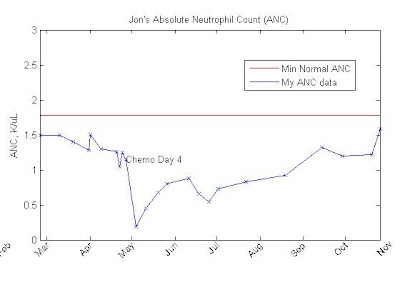


The NCI threshold for remission is 1.5. As you can see, my neutrophils are now at their highest level since I've been collecting CBC data. I'm very relieved, but I'm ready to keep going.

I'll keep you posted.


Update: I just received the peripheral and BMA flow results. The percentage of hairies in the peripheral bloodstream is down to .2%. The percentage in the marrow aspirate is 4%. Thus, MRD has been detected at 6 months post-chemo. I'll go in for another BMA procedure on Monday. The current plan is to see if the BMA hairies will clone before starting Rituxan. This will take a week, so we'll hold off treatment until November 9th.

Tuesday, October 20, 2009

Live Hard

We've finally reached the 6 month post-chemo mark, and I'm feeling good. Since last month's post, I've had two CBCs and blood chemistry tests with some very interesting anecdotal evidence regarding caffeine and blood counts.

After my testing in August, I blogged about some research which indicated that caffeine can lower TNFa levels and hypothesized that since some research indicates that HCL apparently thrives on TNFa, maybe drinking coffee and consuming other TNFa lowering foods may improve or sustain my response.

The results from August to September were markedly improved. Upon seeing my liver function test results in September, I stopped taking the neurology drugs for my tinnitus and stopped drinking coffee and omega-3 supplements (fish oil has also been shown to lower TNFa). I was asked to come in two weeks later (September 29th) for a another blood sample so they could try to clone my hairies for PCR one last time before Rituxan treatments start, and they offered to do another CBC and chemistry as well (Nurse R went out of her way to arrange this for me). As shown in the plots below, my red counts, platelets and ANC all decreased in the two weeks between September 14th and September 29th, when I had ceased the coffee, chamomile tea and fish oil.

After getting the September 29th results, I decided to start taking the coffee, tea and fish oil supplements again before my next test, which was today. As you can see, there was improvement in all the counts from September 29th to October 23rd. Obviously this data is only anecdotal but nonetheless interesting in that it correlates with the presence of the anti-TNFa beverages and supplements.


Anyway, I'm now the proud owner of a Keurig single cup coffee brewer. I may even buy one for my office so I can avoid the battery acid that they try to pawn off as coffee. During the daytime, my co-workers know me as mild-mannered Mr. Coffee, not knowing my secret identity -- Java Man -- killer of hairy buggers everywhere (at least the ones in my bone marrow).

Tomorrow, I go in for my 6 month MRI, and my bone marrow biopsy (BMB) is scheduled for Monday, the 26th. Assuming it will take a week to get the pathology report, I expect to start Rituxan either Monday November 2nd, or the following Monday, November 9th. The first round will be administered over an 8 to 10 hour period, and I'll stay at the hospital overnight to make sure I don't have any adverse reactions. Many patients develop fever and vomit during the first round, but most respond with minimal side effects. After the first round, the time to administer subsequent rounds decreases to around 4 hours.

With respect to my daily activities, life is as normal as it's ever been. I haven't had a nose bleed in months, and even though my neutrophils are low, I still engage in pretty much all the activities I would have were I HCL-free. I try to bike 8 miles on Tuesday and Thursday and anywhere from 18 to 20 on Saturday. We've been to several county fairs and recently took Claire to a local Fall festival where we saw pigs and milking cows, rode slides and took a hay ride. I've added some pictures for everyone to enjoy.


Likewise, I'm pleased to announce that baby #2 is now on the way and doing very well -- just in time prior to starting the Rituxan. Once the Rituxan starts, natural conception must be avoided for at least 1 year. In the immortal words of Andy Dufresne: "Get busy living, or get busy dying." I choose to live hard.

Monday, September 28, 2009

Still Running Up That Hill

My last blood test was two weeks ago and the results are mixed. On the positive side, all my red counts are now above the low end of normal and my neutrophils are higher than they were the day before I started treatment. This is good news which means the Cladribine must have had an effect on the hairy cells in my marrow. Unfortunately, all of my white counts (including the neutrophils) are still well below the low end of normal, which makes me a minor responder -- part of 5% of patients for whom Cladribine treatment does not result in a complete or partial remission.

The latest FACS results indicate that the level of hairies in my peripheral bloodstream is 0.25% (wrt mononuclear cells), so no change since late July. The binding capacity of my hairies for the anti-CD20 monoclonal antibody Rituximab (aka Rituxan) is still over 100k, which means the Rituxan should work well. Unless a miracle happens between now and my CBC and BMB in October, I will still have minimum residual disease (MRD) and undergo treatment with 8 cycles of Rituxan (once a week for 8 weeks), which Dr. K believes "may eradicate the disease."

I'm on cruise control now. Hopefully, the Cladribine has peeled away enough layers of the onion to let the Rituximab finish the job. The veins leading to my marrow that were once clogged with hairies (I compare it to hairy algae clogging the tubing in a fish tank) should be cleared out and ready to let the Rituximab into my marrow.

Here're my latest CBC plots:


I like the acceleration in the red counts. Maybe all that coffee and chamomile drinking helped after all...

I'm going back in tomorrow to have more blood drawn to see if they can clone my hairies for PCR before we start the Rituxan treatments. I'm not sure if this means none of the prior attempts worked or not. Maybe they just want to ensure that they have a "fresh" clone in case the chemo caused mutations or some sort of genetic natural selection in which the surviving hairies are somewhat altered from the general pre-chemo population of clones that were produced. The clones are used in the PCR process to detect 1 hairy cell from 1 million blood cells vice the current state of the art of 1 in 10,000.

If they get the cloning and PCR detection technique to work, it may lead to earlier detection and use of Rituxan as a standard therapy to attack the disease early on when tolerable doses of Rituxan alone can eradicate it. Of course there is always the argument that if the blood counts haven't been affected, there's no need to treate the disease, but if cure can be demonstrated, then this argument may need to be re-examined.

Friday, September 4, 2009

RF Radiation, Cancer and HCL Epidemiology

Here's an interesting article from the Amateur Radio Relay League (ARRL) that discusses RF Radiation Safety and studies that address the association between high-level RF Radiation exposure and cancer:

http://www.wave-guide.org/library/arrl.html

Here's an excerpt from a study of the epidemiology of Hairy Cell Leukemia:

HCL risk was concentrated in white males; there were few black and Asian patients for analysis. Overall, the age-adjusted incidence rate of HCL for men (2.9/million population) was 4.8 times greater than that for women (0.6/million population). Using data from all cancer patients diagnosed during the study period, Jewish men had significantly greater risk of HCL than Protestant men.

For men, the OR was significantly elevated for professional and technical workers (OR = 2.1, P = 0.001); within this category of occupations, risk was significantly elevated for engineers (OR = 4.0, P = 0.0008). HCL patients were more than twice as likely to have multiple primary cancer diagnoses as other cancer patients. Since the majority of the other primary cancer diagnoses occurred prior to (>1 year) or concurrent with (1 year) the HCL diagnosis, this greater frequency of multiple primaries in HCL patients may be due to impaired immune function.

Friday, August 28, 2009

The One-Two Knockout

Good news for patients who don't respond to Cladribine. I found a study citation that shows that even for minor/non-responders to 2-CDA, complete remission after treatment with Rituximab was achieved.

A study at the University of Pisa, Pisa Italy, studied a cohort of 10 patients who followed a treatment regimen very similar to the one I'm in at NIH. Patients were first treated with a course of 2-CDA (chemo) followed by Rituximab 6 months later. Here's the study citation:

Purine analogues have dramatically improved the outcome of patients affected by hairy cell leukemia (HCL), although complete eradication of disease was achieved in few cases. The purpose of this study was to evaluate the role of Rituximab in eradicating minimal residual disease (MRD) in HCL patients after a pre-treatment with 2-chloro-deoxy-adenosine (2-CdA). Ten patients received four cycles of Rituximab after administration of Cladribrine. Before starting anti-CD20 antibody, two patients were in complete remission, six in partial remission and two showed no significant response to Cladribrine. All cases resulted IgH-positive. Median time from the last 2-CdA infusion was 5.7 months. Eight of 10 patients [four in partial remission (PR), two in complete remission (CR) and two unresponsive after 2-CdA] were evaluable for response. Two months after the end of anti-CD20 therapy, all evaluated patients presented a complete haematological remission. Moreover, Rituximab increased percentage of molecular remission up to 100% 1 yr after the end of treatment. Interestingly, in all cases but one, including those persistently polymerase chain reaction (PCR)-positive, semi-quantitative molecular analyses showed MRD levels lower than those found before Rituximab administration. Toxicity was very mild. The present results not only confirm the therapeutic effect of Rituximab, but also show its relevance in eradicating MRD in HCL.

The really great news here is that of 8 patients, 2 were non-responders at 6 months post-chemo, yet all achieved complete remission after treatment with Rituximab biological therapy, and the toxicity was very mild.

There is still plenty to hope for, and I'm glad I found the NIH study.

Wednesday, August 26, 2009

Plan B

A few months back I discussed how HCL thrives in the presence of a cytokine (cell signaling molecule) called tumor necrosis factor alpha (TNFa). Given my less than 3-sigma response to Cladribine, I thought it might be worth investigating foods and medicines that suppress the production of TNFa to help me bide my time.

I asked Dr. K (via e-mail) whether they monitor TNFa in the routine blood tests they perform. He said they used to but found the data to be not very meaningful. I assume this means there was too much variance in the data. I then asked him whether given the overall trend in my data, I'm considered a minor responder. He did not respond to that question.

I had read an article in Tallman and Poliak that discussed how TNFa reducing drugs given in parallel with 2-CdA improved response rates in HCL, so I did my own search regarding foods that lower TNFa and struck gold immediately.

As described in "Caffeine suppresses TNFa production via activation of the cyclic AMP/protein kinase A pathway", Horrigan et al, International Immunopharmacology, Vol. 4, No. 10-11 (October, 2004) pp. 1409-1417 -- coffee can suppress TNFa and thus may be helpful in suppressing the rate of cloning of HCL cells. The most caffeinated food (aside from sugar laden jolt and Red Bull) is restaurant prepared espresso. Here is the paper's abstract:

This study investigated the effect of in vitro exposure to caffeine, and its major metabolite paraxanthine, at concentrations relevant to typical caffeine consumption in humans, on lipopolysaccharide (LPS)-stimulated cytokine production in human whole blood. In addition, a role for the cyclic AMP/protein kinase A (PKA) pathway in the immunomodulatory effect of caffeine was investigated. Diluted whole blood (taken following >/=15 h abstinence from caffeine-containing food and beverages) was preincubated with caffeine or paraxanthine (10-100 microM) and stimulated with LPS (1 proportional, variant g/ml) for 24 h. The proinflammatory cytokines tumour necrosis factor (TNF)-alpha, interleukin (IL)-1beta and IL-12, and the antiinflammatory cytokine IL-10 were measured in cell-free supernatants. Whilst caffeine and paraxanthine had little or no effect on IL-10, IL-1beta, or IL-12 production, TNF-alpha production was suppressed in all individuals studied. The effect was statistically significant at 100 microM and consistent across seven experiments performed. Although not statistically significant, a similar effect was observed with paraxanthine. Caffeine (100 microM) also increased intracellular cyclic AMP concentrations in LPS-stimulated monocytes isolated from whole blood. Moreover, the effect of caffeine on TNF-alpha production was abolished by pretreatment with the protein kinase A inhibitor Rp-8-Br-cAMPS (10(-4) and 10(-5)M). To conclude, this study demonstrates that concentrations of caffeine that are relevant to human consumption consistently suppress production of the proinflammatory cytokine TNF-alpha in human blood and that this effect is mediated by the cyclic AMP/protein kinase A pathway.

I'm going to add one espresso a day to my morning routine in the hope that it will stop the strong cells from signaling further reproduction and infiltration of my marrow. With any luck, I might be able to tip the balance and hold off the stronger cells from reproducing while the chemo continues to take out the weaker ones. Then the Rituximab can come in and wipe out the cells that the chemo couldn't take out.

Foods containing Lutolein (a flavonoid) like celery, green pepper, and chamomile, also suppress TNFa. Other TNFa inhibitors include Nettle Leaf, and ECGC (found in Green Tea). Vitamin A also appears to help suppress TNFa production, which is also linked to the onset of diabetes ("Vitamin A may suppress type 1 diabetes", L. Crowley, Mar. 31, 2008).

I'll be adding all of these to my regular diet.

I wonder if previous studies of TNFa levels proved to be meaningless because diet can affect the levels. Without a controlled diet, studying TNFa levels may prove futile.

TNFa is also associated with demyelinating disorders such as multiple sclerosis and certain forms of tinnitus. Given the fact that Cladribine is effective in treating MS and HCL, I think a logical hypothesis is that Cladribine may somehow block TNFa signalling pathways, possibly by amplifying a protein kinase pathway. Perhaps in minor responders, there is a genetic difference which reduces this effect. A study of individuals who drank a V8-like beverage for 26 days showed they reduced their TNFa production by 34.4%.

Wish me luck!

Monday, August 24, 2009

Keep on Truckin'

I underwent chemotherapy (Cladribine -- aka Leustatin) four months ago and although 99% of the malignant cells in my peripheral blood have died off, my bone marrow response has been very slow. Dr. K wants me to remain on a one-month blood work follow up. As you can see in the graph below, my platelet count is still hovering around 100. I think that the count may be deceptively low because the platelets may be aggregating and fooling the FACS into counting what are multiple aggregate platelets as a single platelet. I'm going to ask Dr. K if he can order a peripheral smear slide examination (direct microscope examination by a pathologist) to see if this might be the case.


The good news is that my WBC, RBC, neutrophil and other counts continue to increase, although slowly. Some other counts, like Basophils, that were previously imperceivable, have now started registering.


Full disclosure -- I took 100 mg of grape seed extract (GSE) per day for a week back in June -- after my platelets had gone to 131, but before the next test showed them crashing back down to 100. Dr. K didn't have a problem with it (probably because he doesn't think it'll do anything), but given GSEs apoptotic effects on Jurkat leukemia cells, I thought it might also help destroy HCL cells too. The studies conducted by City of Hope indicated that GSE wouldn't harm healthy cells; however, I'm concerned that the GSE might have somehow knocked down my bone marrow's progenitor cell production. Still, there hasn't been enough data collected on GSE's effects in humans to know for sure.


I found an article addressing the efficacy of injecting Cladribine intravenously -- "Treatment of hairy cell leukemia with cladribine (2-Cda) by subcutaneous bolus injection: a phase II study," by Rohr et al, Annals of Oncology, 2002. I believe it is the basis for Dr. K's decision to use this method of administration in his clinical trial. The median time to failure for this approach is approximately 38 months. That sounds bad, but I think what it really means is that once a complete remission is achieved, it usually takes 38 months before any malignant cells are detected again. It may take much longer before the marrow and blood counts are affected, requiring a second round of chemotherapy.


Using this approach resulted in an overall remission rate of 97% (76% complete, 21% partial). Complete response requires the dissapearance of all evidence of disease, a return to normal peripheral blood counts, and the absence of hairy cells in the blood stream and the bone marrow. Time to failure is defined as the time between treatment start and progression, relapse, second tumor, or death, whichever occurs first. A partial response also requires a return of all blood counts to normal, but the reduction of cells in the marrow is somewhere between 50 and 99 percent.


PRs and CRs usually occur within 10 weeks after chemotherapy, so I'm bummed because it's been 16 weeks and my blood counts are still below normal and malignant cells, however slight, are still being detected in my bloodstream. That makes me part of the 5% considered minor/no response, so I'm glad I'm in the trial. Hopefully, what the Cladribine doesn't kill, the Rituxan I'm getting in October (once a week for 8 weeks) will.


(More at the bottom of this blog post...)


I've lost a total of 16 pounds over the last two months -- mostly excess fat. I'm down to 188 pounds and holding steady now. My endurance is great, but I have been feeling dizzy lately. I'm anxious for my next bone marrow biopsy in October and to get started on the Rituxan.


I also have a theory on what may have caused my leukemia. Several fellow HCLers have written to me noting that they are also RF engineers or hobbyists, wondering if there may be a common association between our line of work and the disease. A common factor in all of us is that we experienced high-power RF burns over 10 years ago. Likewise, electrical linemen also seem to have a slightly higher incidence of leukemia. Back in 1998, I received a 20 to 40 Watt RF burn at 137.5 MHz when a fellow engineer indicated he had turned off a transmitter but had not. When I disconnected the transmitter's output cable to reconfigure the system for another test, I received a severe RF burn on my hands that took several weeks to heal. In some people, RF burns may cause cellular mutations and induce HCL, but until some meaningful data is collected to prove this, I won't know for sure.


Regardless, bad things happen every day. You just have to accept it and keep on trucking.


KOT!